AI estimate as of October 1, 2025 · verify with a professional before acting
AI-Generated · Verify before acting
Everything on this page is generated by AI for informational purposes only. AI can make mistakes — the AI may misidentify items or misattribute them (artist, maker, brand, designer, origin, era). This is not an official valuation and should not be used for insurance, sale, tax, estate, legal, or lending purposes — or any decision requiring a certified appraisal. It is not an authoritative claim about any person, brand, or rights holder — do not share or rely on it as a factual statement about a third party. Always consult qualified professionals before making financial decisions.
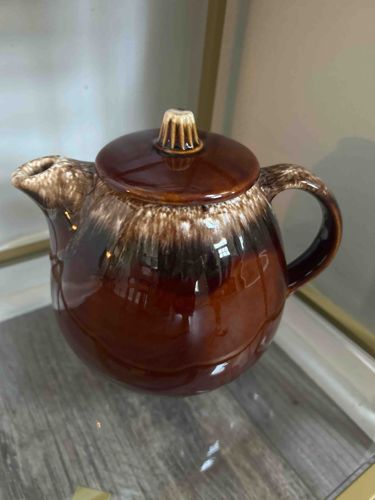
This item is a ceramic teapot, likely manufactured by Hull Pottery, featuring their iconic 'Brown Drip' glaze pattern. The teapot has a bulbous, rounded body, a curved handle, and a short spout with an integrated filter or strainer at its opening. The primary color is a rich, glossy dark brown, often referred to as 'espresso' or 'chocolate' brown, which covers the majority of the body and the lid. A distinctive feature is the ‘drip’ glaze effect, where a lighter, creamy beige or off-white glaze is applied over the dark brown, particularly around the shoulder, rim of the pot, and the top circumference of the lid. This lighter glaze appears to have flowed downwards, creating vertical streaks and an organic, textured appearance before solidifying. The lid is also dark brown with the drip effect around its edge and is topped with a fluted or ribbed finial in a lighter, off-white or beige color, matching the drip glaze. The handle is an open-loop style, generously sized for comfortable gripping, and also exhibits the brown drip glaze. The teapot appears to be in good vintage condition with a high-gloss finish, suggesting it has been well-preserved with no obvious chips, cracks, or significant wear visible from this perspective. Minor surface abrasions or crazing, common in older ceramics, can only be determined upon closer physical inspection. This style of pottery, particularly with the brown drip glaze, was immensely popular in American kitchens from the 1960s to the 1980s, placing its estimated age within that period. The craftsmanship is utilitarian yet decorative, characterized by sturdy construction and a visually appealing, durable glaze.
AI Appraisal Report
Based on my visual examination of the provided image, this Hull Pottery Brown Drip Teapot appears to be in very good vintage condition. The high-gloss finish suggests minimal use and proper care. I observe no obvious chips, cracks, or significant wear, which is crucial for maximizing value in vintage ceramics. The iconic ‘Brown Drip’ glaze pattern is well-executed, with clear distinctions between the dark brown and the lighter beige drip effect. This style is highly recognizable as Hull, though definitive authenticity without a visible maker's mark or in-person inspection remains an assumption.
Market conditions for Hull Pottery's Brown Drip line are generally stable but not experiencing rapid appreciation. While popular in its era (1960s-1980s), it's not considered rare. Comparables on online marketplaces and antique dealers show similar teapots in good condition typically selling in the $20-$50 range. Demand is modest, driven mainly by collectors of vintage kitchenware and ceramic enthusiasts. The lack of rarity means that condition is paramount to achieving the higher end of its market value.
Factors significantly impacting value include the excellent apparent condition and the completeness with its original lid. Any chips, cracks, significant crazing, or repairs would drastically reduce its worth. My primary limitation in this appraisal is the absence of a physical examination. I cannot verify the presence of a Hull Pottery mark, nor can I detect subtle crazing, hairline cracks, or repairs that might not be visible in an image. Full authentication would ideally require an in-person inspection to examine the base for maker’s marks and a meticulous physical assessment of the entire surface for imperfections.