These notes were written by the person who submitted this item. Appraiser.AI has not verified them, and the AI's identification and estimate may rely on them.
AI Estimated Value
Not an official valuation
$8 - $15
AI estimate as of August 20, 2025 · verify with a professional before acting
AI-Generated · Verify before acting
Everything on this page is generated by AI for informational purposes only. AI can make mistakes — the AI may misidentify items or misattribute them (artist, maker, brand, designer, origin, era). This is not an official valuation and should not be used for insurance, sale, tax, estate, legal, or lending purposes — or any decision requiring a certified appraisal. It is not an authoritative claim about any person, brand, or rights holder — do not share or rely on it as a factual statement about a third party. Always consult qualified professionals before making financial decisions.
This analysis also relies on unverified notes provided by the user, which may be incomplete or inaccurate and could affect the result.
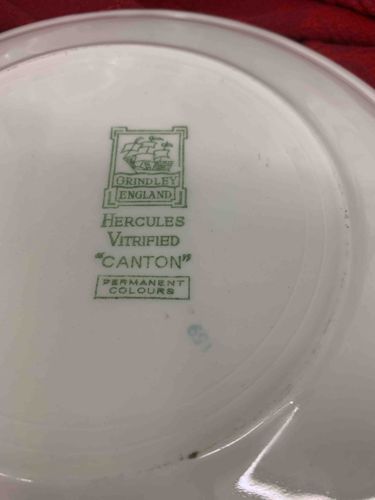
The item is a white ceramic plate, specifically the back (underside) is visible. It has a slightly concave shape typical of dinner plates, with a raised outer rim. The material appears to be a type of vitrified ceramic, likely porcelain or ironstone, given the 'VITRIFIED' marking, which indicates a very durable, non-porous finish. The predominant color of the plate itself is off-white or cream.
Several distinguishing marks are visible, all printed in a dark green color. At the top, within a rectangular border, there is an illustration of a sailing ship, above the words 'GRINDLEY ENGLAND'. Below this, enclosed in another rectangular border, is 'HERCULES VITRIFIED'. Further down, the pattern name '"CANTON"' is prominently displayed in quotes. Finally, at the bottom, within yet another rectangular outline, are the words 'PERMANENT COLOURS'. These markings collectively identify the manufacturer, the material, the specific pattern, and a characteristic of the applied decoration.
In terms of condition, the plate appears to be generally clean with some minor surface inconsistencies. There are a few small dark specks, possibly residue or small chips in the glaze, visible towards the bottom right. There is also a faint blue or green numeral '651' or '851' written directly on the ceramic surface, likely an inventory or production mark. The overall impression is one of use but not significant damage.
The 'Grindley England' mark suggests a British origin, and the 'Hercules Vitrified' and 'Permanent Colours' indicate a robust, long-lasting product, typical of mid-20th century dinnerware designed for everyday use. While no precise date is stated, the style of the backstamp and manufacturing terms points to a production period likely from the mid-1900s, possibly 1930s-1970s. The quality indicates a mass-produced item rather than high-end artisan work, but the vitrified nature points to good craftsmanship for its intended purpose.
AI Appraisal Report
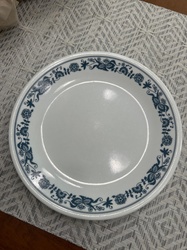
After a thorough review of the provided images and details, I have assessed this Grindley England dinner plate. The item presents as a genuine piece of mid-20th century English dinnerware, specifically from the 'Canton' pattern line, produced with the durable 'Hercules Vitrified' body. The backstamp, featuring a sailing ship and clear markings for the manufacturer, pattern, and material, is consistent with Grindley's production from approximately the 1930s to the 1970s. The plate's condition appears good for its age, showing signs of use but no major cracks, crazing, or significant chips based on the visual evidence. The mention of a floral pattern on the face is characteristic of the 'Canton' design.
The market for individual, mass-produced dinner plates from this era is generally modest. While the 'Hercules Vitrified' line was known for its durability and quality, it was widely produced and is not considered rare. Comparable sales for single Grindley 'Canton' dinner plates on online marketplaces and replacement china services typically fall within a low price range. The primary value driver is its utility as a replacement piece for someone completing a set, rather than its intrinsic collectible value as a standalone item. The presence of minor specks or potential small glaze chips, as noted, slightly detracts from a 'mint' condition valuation.
It is important to note that this appraisal is based solely on images. A full authentication would require in-person examination to assess the glaze integrity, check for hairline cracks not visible in photos, and verify the weight and feel of the ceramic. Without physical inspection, the presence of subtle repairs or damage cannot be definitively ruled out.