These notes were written by the person who submitted this item. Appraiser.AI has not verified them, and the AI's identification and estimate may rely on them.
AI Estimated Value
Not an official valuation
$75 - $150
AI estimate as of December 12, 2025 · verify with a professional before acting
AI-Generated · Verify before acting
Everything on this page is generated by AI for informational purposes only. AI can make mistakes — the AI may misidentify items or misattribute them (artist, maker, brand, designer, origin, era). This is not an official valuation and should not be used for insurance, sale, tax, estate, legal, or lending purposes — or any decision requiring a certified appraisal. It is not an authoritative claim about any person, brand, or rights holder — do not share or rely on it as a factual statement about a third party. Always consult qualified professionals before making financial decisions.
This analysis also relies on unverified notes provided by the user, which may be incomplete or inaccurate and could affect the result.
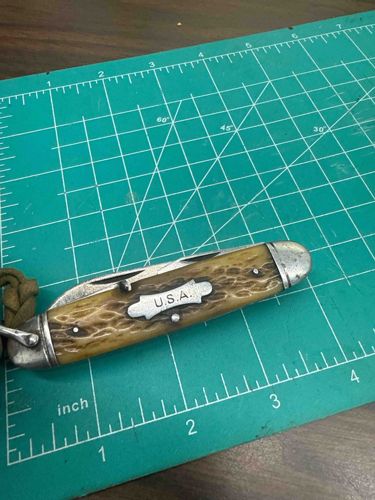
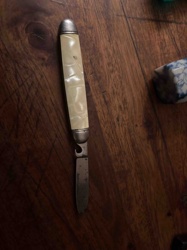
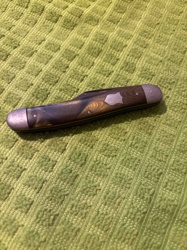
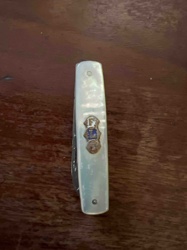
This is a vintage pocket knife, likely dating from the World War II era, consistent with an engineer's service tool. The knife measures approximately 3.25 inches in length when closed, based on the visible ruler markings. It features jigged bone or synthetic celluloid scales (handles) with a rich, mottled brown and tan coloring, mimicking a stag or bone appearance. The scales are secured to the frame with at least four visible metal pins. The bolsters, visible at both ends of the knife, are made of a silver-toned metal, possibly nickel silver or steel, and show significant wear, pitting, and tarnishing, indicative of age and extensive use. A prominent shield-shaped escutcheon plate with 'U.S.A.' stamped or engraved into it is affixed to one side of the handle, centrally located. This marking strongly suggests a military issue or patriotic themed item from the United States. A woven, dark-colored lanyard or cord is attached to a bail or ring at the bolster end, suggesting it was designed for secure carrying. The knife appears to be a multi-bladed type, with at least one implement visible in the closed position alongside the main body. The condition suggests considerable age and use, with surface wear, scratches, and a dulling of the metal components, but no apparent major structural damage or repairs. The craftsmanship appears robust and functional, typical of military-issue equipment designed for durability rather than decorative appeal. The unique 'U.S.A.' inlay is a primary distinguishing feature.
AI Appraisal Report
Upon examining the provided images and description, I am appraising a WW2 era U.S.A. Engineer's pattern pocket knife. The item measures approximately 3.25 inches closed and features jigged bone or celluloid handles, nickel silver or steel bolsters, and a bail with a lanyard. The "U.S.A." shield escutcheon is a key feature, suggesting military or government issue. The knife exhibits significant wear, pitting, and tarnishing consistent with its age and use as a field tool. This condition, while demonstrating its history, places it in a 'fair' to 'good' collectible grade.
Several manufacturers, such as Camillus, Ulster, and Imperial, produced similar knives for military contracts. Without a visible maker's mark on the tang of the blade(s), attributing it to a specific, more desirable manufacturer is impossible, which significantly impacts its value. The market for general military-issue pocket knives is steady, driven by military collectors. However, common, unmarked examples are plentiful. Comparable sales for similar unmarked or common-maker WW2 contract knives in this condition typically range from $60 to over $150, with prices at the higher end reserved for well-marked, rarer examples in better condition.
It is crucial to note the limitations of this appraisal, as it is based solely on images. Full authentication requires in-person examination to inspect the blade tangs for manufacturer markings, assess the blade snap and action, and confirm the handle material (bone vs. celluloid). Provenance or documentation linking the knife to a specific engineer or unit would substantially increase its value, but none was provided.