AI Appraisal Estimate

AI-generated estimates · not official valuations

From the user

What was submitted

Photo and notes provided by the user — not generated by AI

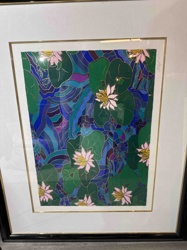
Submitted item photo
Submitted photo · May 24, 2026

User's notes

No additional notes provided.

AI analysis below

AI appraisal

AI analysis & estimate

AI-Generated · Verify before acting

Everything below is generated by AI for informational purposes only. AI can make mistakes — the AI may misidentify items or misattribute them (artist, maker, brand, designer, origin, era). This is not an official valuation and should not be used for insurance, sale, tax, estate, legal, or lending purposes — or any decision requiring a certified appraisal. It is not an authoritative claim about any person, brand, or rights holder — do not share or rely on it as a factual statement about a third party. Always consult qualified professionals before making financial decisions.

Read the full disclaimer

AI Identification

·Not independently authenticated·Verify before acting

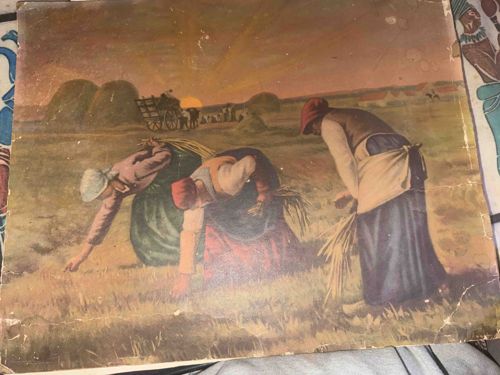
Lithographic Print of 'The Gleaners' by Jean-François Millet

Fine Art Prints and Multiples

AI Estimated Value

·Not an official valuation·Verify before acting

$15.00 - $35.00

As of May 24, 2026

AI Item Analysis

·AI can make mistakes·Verify before acting
This item is an antique or vintage lithographic color print depicting the famous 1857 oil painting 'The Gleaners' (Des glaneuses) by Jean-François Millet. The artwork shows three peasant women laboring in a field to glean the remains of a wheat harvest under a setting sun. The print is rendered on a stiff paper or board substrate and measures approximately medium-sized, likely intended for home decoration. The color palette features earthy tones of gold, ocher, and muted blues and reds, typical of 19th-century Realism. The condition of the piece is fair to poor, showing significant age-related wear. There are visible white scuffs and scratches across the surface, particularly in the upper sky area and bottom edge, indicating loss of the printed surface. The corners are severely bumped and frayed, and there is a noticeable vertical crease or tear on the right edge. No artist signature or specific printer's mark is visible in the provided image, though such mass-produced prints often originated from early 20th-century lithography houses. The style exemplifies Rural Realism, focusing on the dignity of manual labor. The heavy patina and edge damage suggest the piece has been storage-worn or handled without a frame for an extended period.

AI Appraisal Report

·AI can make mistakes·Verify before acting
I have conducted a visual examination of the lithographic print after Jean-François Millet’s 'The Gleaners.' This item is a photomechanical reproduction, likely a mid-20th-century mass-produced lithograph intended for the decorative market. It is not an original 1857 oil painting nor a high-value hand-pulled lithograph by the artist himself. The condition is significantly compromised, categorized as 'Poor.' I observed extensive surface loss in the sky and foreground, severe bumping of the corners, and a structural vertical crease on the right margin. The substrate shows signs of acidity and brittleness. Unlike original 19th-century Millet prints which carry high demand, these commercial reproductions were printed in the thousands. Market demand for heavily damaged, common reproductions of famous works is negligible. Collector interest is driven by rarity and state; since this piece lacks a signature, limited edition numbering, or a prestigious printer’s mark, its value is purely decorative or sentimental. The current market for 'damaged decorative items' of this type is found primarily at the lower tier of estate sales or flea markets. Limitations: My assessment is based solely on digital images. A physical inspection would be required to confirm the exact printing process (e.g., offset lithography vs. earlier chromolithography) and to examine the paper’s watermark or verso for origin marks. Scientific testing of the ink chemistry or paper fibers would be necessary to establish a precise manufacturing date, though the visual evidence of mechanical dot patterns suggests it is not an antique of significant age. Provenance documentation would be required to elevate it above a common secondary-market find.

Get your items appraised

Instant estimates of your treasures with AI-powered appraisals

Browse More Appraisals