These notes were written by the person who submitted this item. Appraiser.AI has not verified them, and the AI's identification and estimate may rely on them.
AI Estimated Value
Not an official valuation
$25 - $45
AI estimate as of September 16, 2025 · verify with a professional before acting
AI-Generated · Verify before acting
Everything on this page is generated by AI for informational purposes only. AI can make mistakes — the AI may misidentify items or misattribute them (artist, maker, brand, designer, origin, era). This is not an official valuation and should not be used for insurance, sale, tax, estate, legal, or lending purposes — or any decision requiring a certified appraisal. It is not an authoritative claim about any person, brand, or rights holder — do not share or rely on it as a factual statement about a third party. Always consult qualified professionals before making financial decisions.
This analysis also relies on unverified notes provided by the user, which may be incomplete or inaccurate and could affect the result.
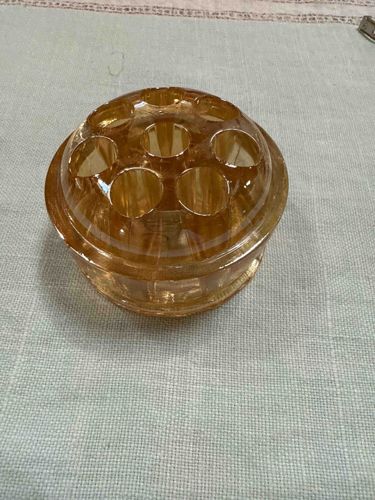
This item is a circular, dome-shaped flower frog, approximately 2.5 inches in diameter, crafted from iridescent amber-colored glass, commonly known as carnival glass. The glass exhibits a rich, warm golden-orange hue with a subtle rainbow-like shimmering effect, characteristic of carnival glass, which becomes particularly apparent under direct light. The top surface of the frog is perforated with a total of seven holes, arranged in a central hole surrounded by six evenly spaced holes in a circular pattern. These holes are designed to hold flower stems upright when the frog is placed in a vase or bowl. The sides of the flower frog feature a molded, possibly geometric or decorative pattern, though the exact details are difficult to discern from the provided image due to the angle and lighting, appearing as a series of vertical ribs or panels. There are no visible chips, cracks, or significant damage to the glass, suggesting it is in good vintage condition. Minor surface wear consistent with age and use, such as light scratching or scuffing, may be present but is not clearly visible. The craftsmanship appears to be typical of mass-produced pressed glass from the early to mid-20th century. There are no apparent maker's marks or signatures visible on the exterior. Its design and material suggest an estimated age from the 1920s to the 1950s, a popular period for carnival glass production and the use of flower frogs for floral arrangements.
AI Appraisal Report
Upon examining the provided image and information for this 2.5-inch iridescent amber carnival glass flower frog, I can provide the following appraisal. The item appears to be in good vintage condition, with no visible chips, cracks, or significant damage. The characteristic iridescence of carnival glass is evident, displaying a warm golden-orange hue with rainbow-like shimmer, which is desirable. The seven-hole configuration is standard for a flower frog of this size and period. The molded design on the sides, though indistinct, is typical for pressed glass items of the early to mid-20th century, consistent with the estimated age range of the 1920s-1950s. The absence of apparent maker's marks is common for many such utilitarian carnival glass pieces.
From a market perspective, carnival glass flower frogs, while collectible, generally do not command extremely high prices unless they are from a highly sought-after pattern, an unusual color, or a rare maker. Demand for common forms like this tends to be moderate. Similar items in good condition typically sell in the $20-$50 range, influenced by the exact pattern, color vibrancy, and specific buyer interest. This particular piece, being a common size and color, falls within the typical range. The lack of clear pattern identification due to image limitations slightly impacts the upper end of the valuation.
The primary limitation of this appraisal is that it's based solely on images and provided descriptions. A definitive assessment of condition, authenticity, and pattern details would require a physical examination to check for any hairline cracks, surface roughness, manufacturing flaws not visible, or subtle variations in iridescence. Without in-person inspection, it's impossible to completely rule out minor repairs, although none are suggested by the provided visuals. Provenance documentation could also enhance value, but it is not available here.