AI estimate as of October 22, 2025 · verify with a professional before acting
AI-Generated · Verify before acting
Everything on this page is generated by AI for informational purposes only. AI can make mistakes — the AI may misidentify items or misattribute them (artist, maker, brand, designer, origin, era). This is not an official valuation and should not be used for insurance, sale, tax, estate, legal, or lending purposes — or any decision requiring a certified appraisal. It is not an authoritative claim about any person, brand, or rights holder — do not share or rely on it as a factual statement about a third party. Always consult qualified professionals before making financial decisions.
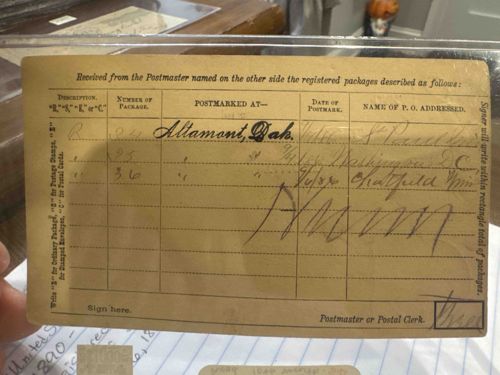
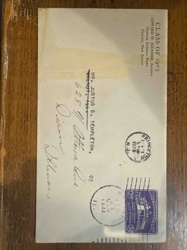
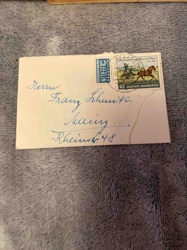
This item is an antique or vintage postal service registered package notification card, likely dating from the late 19th to early 20th century. The card is a pale, slightly faded manila or buff-colored cardstock, rectangular in shape, with printed lines and text in black ink. The overall size appears to be standard postcard dimensions, though exact measurements are not discernible from the image. The card is designed to record details of registered packages received from a postmaster. Key physical characteristics include a grid-like layout for columns such as 'DESCRIPTION', 'NUMBER OF PACKAGE', 'POSTMARKED AT—', 'DATE OF POSTMARK', and 'NAME OF P. O. ADDRESSED.'. There's also a column for 'DESCRIPTION' instructing to 'Write "R" for Ordinary Package, "G" for Postage Stamps, "E" for Stamped Envelopes, "C" for Postal Cards'. Handwritten entries are visible on the card, filled in with dark ink. For example, 'Altamont, Dak.' is written under 'POSTMARKED AT—', indicating a postal location in Dakota Territory (likely North or South Dakota before statehood, or soon after). Other handwritten entries include package numbers '24', '25', and '36', and what appear to be names and addresses such as 'S. Treuett' and 'Washington D.C.'. The bottom left corner has 'Sign here.' printed, and the bottom right has 'Postmaster or Postal Clerk' with a large, illegible handwritten signature/marking over it. The text 'Signer will write within rectangle total of packages.' is printed vertically along the right edge. The card shows significant signs of age, including general discoloration, likely a patina from exposure over time, and some faint creasing or bending, particularly visible near the corners. The handwritten entries are bold and legible, indicating good ink quality for the period. The edges appear somewhat worn, but there are no obvious tears or major damage. The simple, functional design suggests a utilitarian purpose, consistent with official postal forms of the era. The handwriting style and the reference to 'Dak.' (Dakota) point towards a late 1800s to early 1900s manufacturing date. The quality of the paper and printing is basic but durable, designed for practical use within the postal system.
AI Appraisal Report
I have examined the provided image of this Early US Postal Service Registered Package Notification Card. Based on my visual assessment, the card appears to be authentic philatelic ephemera from the late 19th to early 20th century. The 'Altamont, Dak.' postmark location is historically significant, placing its usage before or shortly after the Dakota territories became states. Condition-wise, the card exhibits typical age-related wear, including discoloration, some faint creasing, and worn edges, consistent with its utilitarian purpose. The handwritten entries are clear and legible. This item's authenticity is strongly supported by the period-correct printing, paper type, and content, including the specific instruction for 'R', 'G', 'E', 'C' descriptions which aligns with known postal forms of the era.
In terms of market conditions, items like this fall into the broader category of postal history ephemera. While interesting, notification cards are generally less sought after than more visually appealing or historically significant covers or stamps. Comparables often sell in the $15-75 range, depending on specific content, condition, and rarity of the postmark location. A key factor impacting its value is the relatively common nature of such forms. While the 'Dak.' postmark adds a touch of historical interest, it's not exceptionally rare. Demand for such items is steady among specialists in postal history or Dakota philately but not extraordinarily high.
Limitations prevent a definitive authentication solely from an image. A physical examination would allow me to assess the paper's true texture, weight, and watermark (if any), examine the ink for consistency and age under magnification, and confirm exact dimensions and printing methods. Provenance documentation, such as where it was acquired or its chain of ownership, would also strengthen its authentication. Without these, my assessment of authenticity is based on strong visual congruence with known historical examples, but further in-person verification is always recommended for full authentication.