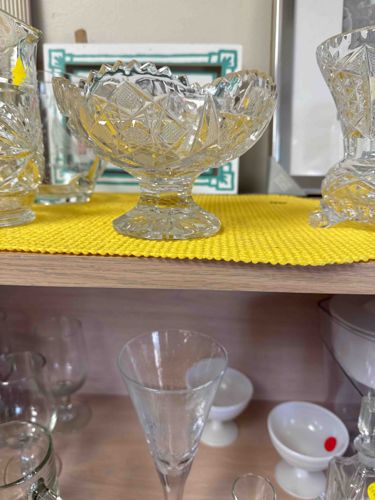
American Brilliant Cut Glass Pedestal Bowl
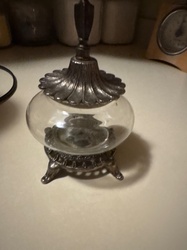
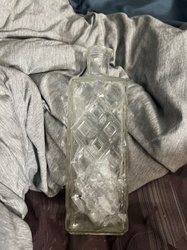
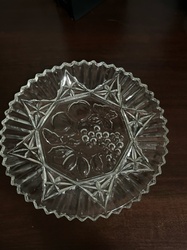
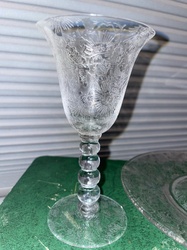
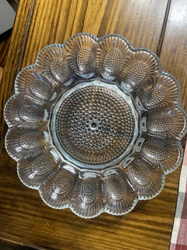
This item is a decorative clear heavy lead glass pedestal bowl, characteristic of the American Brilliant Period (circa 1876-1916). The bowl features an intricate 'Brilliant' cut pattern consisting of deep miter cuts, hobstars, and fine cross-hatching or strawberry diamond motifs that create a high degree of light refraction and 'fire.' Physically, the vessel consists of an undulating, saw-toothed or scalloped rim that slopes inward to a deep well, supported by a short, faceted hexagonal stem and a flared, star-cut circular base. The glass appears to be of high lead content, indicated by its clarity and the sharpness of the wheel-cut edges. While no maker's mark (such as Libbey or Hoare) is immediately visible in the image, the complexity of the pattern suggests high-end manufacturing. The condition appears fair to good; however, typical of sawtooth rims, there may be minor fleabites or micro-chipping along the sharpest peaks. There is a slight yellow tint to the glass in the photograph, which may be due to lighting or environmental reflections rather than the glass composition itself. The craftsmanship displays precise geometric alignment, marking it as a piece of significant decorative value from the early 20th century.
AI-Generated Appraisal Disclaimer
Estimated Value
$450.00 - $650.00
Basic Information
Category
Antique Glassware
Appraised On
January 17, 2026
Estimated Value
$450.00 - $650.00
Item Description
This item is a decorative clear heavy lead glass pedestal bowl, characteristic of the American Brilliant Period (circa 1876-1916). The bowl features an intricate 'Brilliant' cut pattern consisting of deep miter cuts, hobstars, and fine cross-hatching or strawberry diamond motifs that create a high degree of light refraction and 'fire.' Physically, the vessel consists of an undulating, saw-toothed or scalloped rim that slopes inward to a deep well, supported by a short, faceted hexagonal stem and a flared, star-cut circular base. The glass appears to be of high lead content, indicated by its clarity and the sharpness of the wheel-cut edges. While no maker's mark (such as Libbey or Hoare) is immediately visible in the image, the complexity of the pattern suggests high-end manufacturing. The condition appears fair to good; however, typical of sawtooth rims, there may be minor fleabites or micro-chipping along the sharpest peaks. There is a slight yellow tint to the glass in the photograph, which may be due to lighting or environmental reflections rather than the glass composition itself. The craftsmanship displays precise geometric alignment, marking it as a piece of significant decorative value from the early 20th century.
Get Your Items Appraised
Instant estimates of your treasures with AI-powered instant appraisals