AI Appraisal Estimate

AI-generated estimates · not official valuations

From the user

What was submitted

Photo and notes provided by the user — not generated by AI

Submitted item photo
Submitted photo · June 18, 2026

User's notes

No additional notes provided.

AI analysis below

AI appraisal

AI analysis & estimate

AI-Generated · Verify before acting

Everything below is generated by AI for informational purposes only. AI can make mistakes — the AI may misidentify items or misattribute them (artist, maker, brand, designer, origin, era). This is not an official valuation and should not be used for insurance, sale, tax, estate, legal, or lending purposes — or any decision requiring a certified appraisal. It is not an authoritative claim about any person, brand, or rights holder — do not share or rely on it as a factual statement about a third party. Always consult qualified professionals before making financial decisions.

Read the full disclaimer

AI Identification

·Not independently authenticated·Verify before acting

Stretcher Bar and Canvas Assembly (verso view)

Art Supplies/Components

AI Estimated Value

·Not an official valuation·Verify before acting

$50 - $150

As of June 18, 2026

AI Item Analysis

·AI can make mistakes·Verify before acting
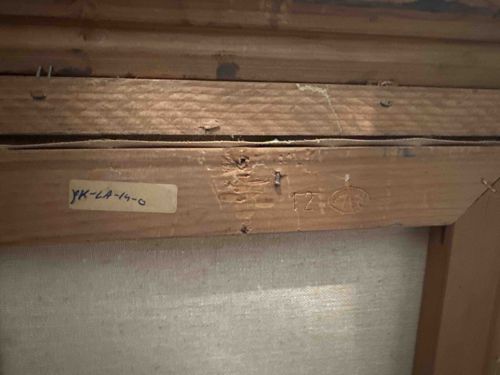
The item is a partial view of the verso (back) of a canvas painting, specifically focusing on a section of its wooden stretcher bar and the reverse side of the canvas. The stretcher bar appears to be constructed from light-colored wood, possibly pine or a similar softwood, showcasing a visible grain pattern. It exhibits a somewhat rustic or utilitarian finish, typical for unseen structural components of artwork. Several small nails or staples are visible, suggesting the method used to secure the canvas to the stretcher. These fasteners appear somewhat oxidized or tarnished with age. There is a notable crack or split running horizontally along one of the stretcher bars, indicating potential stress or drying over time. Distinguishing elements include a rectangular, light-colored label adhered to the wood, with handwritten text 'YK-LA-14-0' in dark ink, likely an inventory or archival number. Partially visible to the right of the label, impressed directly into the wood, are two markings. One appears to be the number '72', and the other is a circular or oval stamp with an indistinct symbol or logo within it, possibly a manufacturer's mark or artist's chop. The canvas material itself, seen lightly stretched across the frame, is a natural, unprimed or unpainted coarse textile, likely linen or cotton, showing its woven texture. The overall condition suggests age, with minor wear and expected patina on the wood. The visible construction methods point to a traditional canvas framing technique. The approximate age is difficult to pinpoint precisely from this view alone but the style of markings and visible wear suggest it could date from the mid to late 20th century.
AI Appraisal Report

·AI can make mistakes·Verify before acting
Based on my visual examination of the provided image, this item is a section of a stretcher bar and the verso of a canvas. The stretcher bar appears to be made of a common softwood, showing a clear grain and some age-related wear, including a noticeable crack or split. The visible nails/staples suggest a traditional, utilitarian construction method. The canvas itself is an unprimed, coarse textile, consistent with natural fibers like linen or cotton. Several markings contribute to its unique identity. A label with 'YK-LA-14-0' indicates it likely belongs to an inventory or collection. The impressed '72' and a circular stamp with an indistinct symbol suggest a potential manufacturer or art studio mark. The condition is consistent with age and typical storage/handling for an art component, not significantly impacting its value as a raw material, but hinting at its past use within a piece of art. This item, in itself, is a component of a larger artwork rather than a standalone piece of art. Therefore, its intrinsic value as 'art supplies/components' is relatively low. The value lies primarily in its potential historical connection to a finished artwork. The market for used stretcher bars or unprimed canvas components is niche and typically limited to artists seeking specific vintage materials or for study purposes. Demand and rarity are low for such a component in isolation. The age, estimated to be mid-to-late 20th century, does not confer significant antique value to a utilitarian component. Factors impacting value would be any confirmed association with a significant artist or artwork, which is currently unknown. Without such provenance, its value remains as a generic, used art component. My appraisal value reflects its material and age in good, used condition. Limitations: Authenticity verification of the markings (particularly the faint stamp) would require in-person examination to assess their nature (ink, impressed, etc.) and to compare them against known manufacturer or artist marks. Full authentication of its connection to a specific artwork would necessitate detailed provenance documentation and, potentially, art historical research or scientific testing of the canvas fibers and wood to match known materials from a particular period or artist.

Get your items appraised

Instant estimates of your treasures with AI-powered appraisals

Browse More Appraisals