AI estimate as of March 22, 2026 · verify with a professional before acting
AI-Generated · Verify before acting
Everything on this page is generated by AI for informational purposes only. AI can make mistakes — the AI may misidentify items or misattribute them (artist, maker, brand, designer, origin, era). This is not an official valuation and should not be used for insurance, sale, tax, estate, legal, or lending purposes — or any decision requiring a certified appraisal. It is not an authoritative claim about any person, brand, or rights holder — do not share or rely on it as a factual statement about a third party. Always consult qualified professionals before making financial decisions.
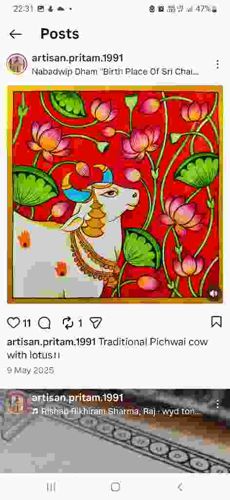
This is a vibrant and stylistically traditional Pichwai painting, an art form originating from Rajasthan, India. The piece features a central white 'Kamadhenu' or holy cow, adorned with gold necklaces, ornate ear jewelry, and horns painted in bright blue and gold. Orange handprints, known as 'mehndi' or 'aalta' marks, are visible on the cow's body, symbolizing blessings and divinity. The background is a striking, saturated red, densely filled with blooming pink lotuses on sinuous green stems accompanied by large, rounded lily pads. The composition follows the classic Pushtimarg tradition, often used as backdrops in Shrinathji temples.
Physically, the artwork appears to be a contemporary creation, likely executed with acrylic or poster colors on a flat surface such as canvas, paper, or conditioned cloth, finished with a simple gold-painted border. The craftsmanship shows clean, bold outlines and smooth color transitions (shading) on the lotus petals, typical of modern interpretations of this folk style. There are no visible signs of aging, cracks, or patina, suggesting it is a new production. The lack of traditional gold leaf (Varak) indicates it is a more accessible, decorative version rather than a high-end antique temple hanging. The piece reflects the 'Kota' or 'Nathdwara' style school with its emphasis on nature and pastoral themes.
AI Appraisal Report
I have conducted a visual analysis of this contemporary Pichwai painting. The work depicts a holy cow (Kamadhenu) amidst a dense lotus pond, rendered in the Nathdwara style. My examination reveals the piece is in excellent condition, showing no signs of pigment loss, cracking, or historical patina. The application of paint is precise and consistent with modern synthetic pigments (such as acrylics or high-grade gouache) rather than traditional mineral pigments. The absence of authentic gold leaf (Varak) and the use of gold-toned metallic paint suggest this is a commercial-grade decorative piece rather than a liturgical or collector-grade antique.
The market for Pichwai is currently bifurcated: while 19th-century temple hangings command five-figure sums, contemporary decorative works are plentiful and produced in high volume in Rajasthan. This piece lacks the 'Antiqued' distressing common in high-end reproductions, positioning it as a modern retail item. Demand remains steady for Indian folk art as interior decor, but the rarity is low given the accessibility of similar motifs.
A significant limitation of this appraisal is the inability to physically inspect the substrate; I cannot confirm if this is on paper, canvas, or cotton without tactile examination. To confirm the top end of the valuation, documentation of the artist's identity or provenance would be required. In-person inspection under ultraviolet light would be necessary to identify any hidden repairs or to definitively distinguish synthetic binders from natural ones. For a full professional authentication, scientific testing of the pigment chemical composition would be needed to verify the absence of modern stabilizers found in mass-produced paints.