AI Appraisal Estimate

AI-generated estimates · not official valuations

From the user

What was submitted

Photo and notes provided by the user — not generated by AI

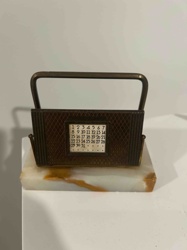
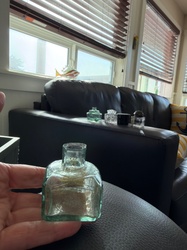
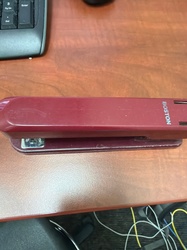
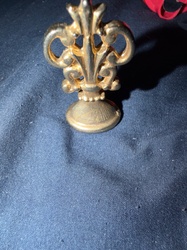
Submitted item photo
Submitted photo · June 30, 2026

User's notes

No additional notes provided.

AI analysis below

AI appraisal

AI analysis & estimate

AI-Generated · Verify before acting

Everything below is generated by AI for informational purposes only. AI can make mistakes — the AI may misidentify items or misattribute them (artist, maker, brand, designer, origin, era). This is not an official valuation and should not be used for insurance, sale, tax, estate, legal, or lending purposes — or any decision requiring a certified appraisal. It is not an authoritative claim about any person, brand, or rights holder — do not share or rely on it as a factual statement about a third party. Always consult qualified professionals before making financial decisions.

Read the full disclaimer

AI Identification

·Not independently authenticated·Verify before acting

Japanese Meiji Period Bronze Inkwell Desk Set

Antiques / Asian Art / Desk Accessories

AI Estimated Value

·Not an official valuation·Verify before acting

$450 - $650

As of June 30, 2026

AI Item Analysis

·AI can make mistakes·Verify before acting
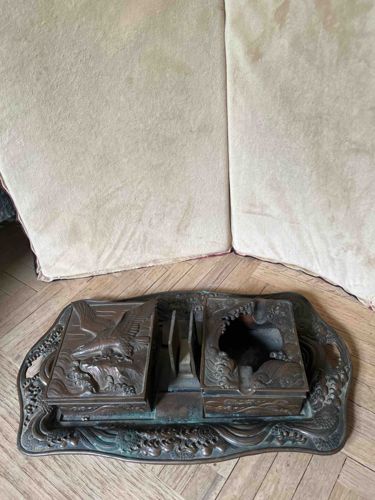
This is a highly ornate, antique Japanese desk set, most likely dating from the Meiji Period (1868-1912). The set is skillfully cast from bronze and features a rich, dark brown patina with significant green oxidation (verdigris) visible in the recessed areas of the tray and base. The set consists of a large, scalloped decorative tray featuring high-relief 'menuki' style wave and dragon motifs. Positioned on the tray are two main receptacles and a central pen or letter rack. To the left is a rectangular lidded box, perhaps for stamps or nibs, featuring an incredibly detailed high-relief casting of an eagle (taka) in flight over crashing waves. To the right is an asymmetrical circular opening, likely designed to hold a glass inkwell insert (which appears missing) or serving as a specialized brush pot/well. The craftsmanship is indicative of high-quality metalwork from the late 19th or early 20th century. Condition-wise, the bronze exhibits significant surface wear consistent with age, including dust accumulation and substantial verdigris corrosion on the flat surfaces of the tray and between the components. No visible cracks are present, but the missing inkwell insert is a notable condition detraction. The overall style is consistent with 'Japanese Export' wares designed for the Western market during the late Victorian or Edwardian eras.
AI Appraisal Report

·AI can make mistakes·Verify before acting
I have completed a visual examination of this Japanese Meiji-period bronze desk set. The piece exhibits the characteristic 'taka-zogan' style of high-relief casting that defined the export market between 1870 and 1910. The eagle and wave motifs are executed with commendable skill, suggesting a mid-to-high tier workshop production common in Yokohama or Nagasaki. The dark brown patina is consistent with age, though the heavy verdigris in the recessed areas suggests it was kept in a humid environment or improperly cleaned in the past. Market demand for Meiji metalwork remains steady, though interest is currently skewed toward signed works by master casters (such as Miyao Eisuke or Genryusai Seiya). This unsigned example, while decorative, faces a value ceiling due to the missing glass inkwell insert and the lack of visible artist markings. Comparable sets at auction typically realize between $400 and $800 depending on the complexity of the motifs. The present condition issues—specifically the oxidation and missing component—place it toward the lower-middle end of that range. Note that this appraisal is based on photographic evidence only. A physical inspection is necessary to verify the base metal composition and check for concealed repairs or cold-painting. To fully authenticate the item, one would need to inspect the underside of the tray and boxes for incised signatures or foundry marks. Scientific testing such as X-ray fluorescence (XRF) could confirm the alloy's consistency with Meiji-era smelting, but given the item's estimated value, provenance documentation or a signature search is the more practical next step for formal valuation.

Get your items appraised

Instant estimates of your treasures with AI-powered appraisals

Browse More Appraisals