These notes were written by the person who submitted this item. Appraiser.AI has not verified them, and the AI's identification and estimate may rely on them.
AI Estimated Value
Not an official valuation
$600-900
AI estimate as of September 27, 2025 · verify with a professional before acting
AI-Generated · Verify before acting
Everything on this page is generated by AI for informational purposes only. AI can make mistakes — the AI may misidentify items or misattribute them (artist, maker, brand, designer, origin, era). This is not an official valuation and should not be used for insurance, sale, tax, estate, legal, or lending purposes — or any decision requiring a certified appraisal. It is not an authoritative claim about any person, brand, or rights holder — do not share or rely on it as a factual statement about a third party. Always consult qualified professionals before making financial decisions.
This analysis also relies on unverified notes provided by the user, which may be incomplete or inaccurate and could affect the result.
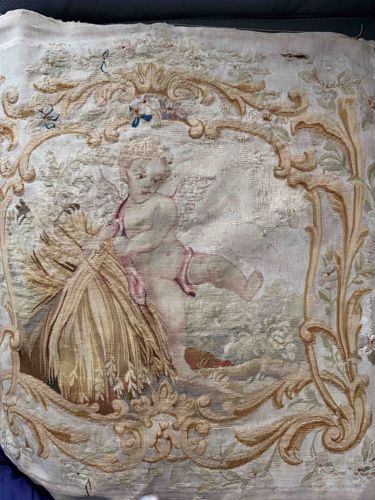
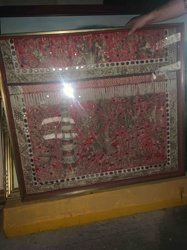
This is a tapestry fragment, likely from a larger work, featuring a central vignette of a cherub cradling a large sheaf of wheat, framed by rococo-inspired floral and acanthus scrollwork. The textile exhibits a finely woven intricate design, characteristic of tapestry weaving. The primary colors visible are muted golds, creams, pastel pinks, and faint blues, suggesting a classical or allegorical theme often found in 18th-century European tapestry art. The cherub's skin tone is a delicate blush pink, and its wings are softly rendered. The wheat sheaf displays various shades of ochre and beige, conveying texture and volume. The surrounding background is a muted green and grey, indicative of a natural, pastoral setting with indistinct foliage. The frame-like border features raised, detailed embroidery or needlework in golden-brown and cream threads, giving it a three-dimensional quality and emphasizing the central image. The visible condition shows significant wear, fraying, and possible discoloration consistent with age and exposure. There are areas where the original yarns appear to be worn thin, revealing the base warp threads, particularly in the background surrounding the cherub. Some small holes or missing threads are discernible in several places, suggesting deterioration. The edges of the fragment are uneven and unfinished, indicating it has been cut or separated from a larger piece. Despite the wear, the quality of the weaving, particularly in the fine delineation of the cherub's features and the intricate border, suggests a high level of craftsmanship. The style and subject matter align with the aesthetics popular during the Rococo period, possibly dating back to the late 17th or 18th century, and could be influenced by or originating from a significant European tapestry workshop like Gobelins or Beauvais, though no specific maker's marks are visible in the image.
AI Appraisal Report
I have examined the provided image of this Gobelins Style Tapestry Fragment with Cherub and Wheat Sheaf. While the owner mentions "Goblin tapestry," it is highly probable they mean "Gobelins" in reference to the renowned French manufacture, given the described style. The fragment displays fine weaving characteristic of 18th-century European tapestry art, featuring a cherub with a wheat sheaf framed by rococo floral and acanthus scrollwork. The color palette of muted golds, creams, pastel pinks, and faint blues is consistent with the period and allegorical themes. The detailed, raised borderwork further suggests high craftsmanship.
However, the condition significantly impacts value. There is considerable wear, fraying, discoloration, and thinning of yarns, particularly in the background, revealing warp threads. Small holes and missing threads are also discernible, and the edges are uneven and unfinished, indicating it was cut from a larger piece. While the quality of the weaving is evident, the damage limits its aesthetic appeal and structural integrity.
Market demand for antique tapestries, especially fragments, is generally moderate. Gobelins-style pieces are sought after, but the extent of restoration needed and the 'fragment' status reduce its desirability compared to a complete, well-preserved tapestry. Comparables for fragments of this size and condition from less renowned workshops typically range from a few hundred to over a thousand dollars, depending on provenance and specific stylistic attributes. Given the evident damage and the likely necessity of significant restoration for display, I would place its value in the $600-$900 range as an decorative antique fragment. For a definitive assessment of authenticity as a genuine Gobelins or Beauvais piece, a hands-on examination is crucial to inspect thread count, dyes, and weave structure, as well as a thorough provenance investigation. Without this, attribution to a specific workshop remains speculative based on style alone.