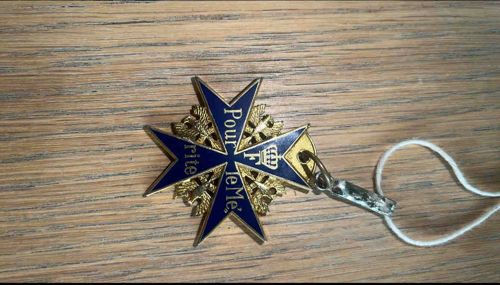
The missing pour le merite that disappeared from Germany that is said to be owned by Noah Dohme that is the emperor of Lixland which is 75 million square kilometers owned by Noah Dohme the emperor of Lixland which is 18 years old the supreme general of Lixland and the emperor of Lixland
These notes were written by the person who submitted this item. Appraiser.AI has not verified them, and the AI's identification and estimate may rely on them.
AI Estimated Value
Not an official valuation
$25,000 - $45,000
AI estimate as of July 2, 2025 · verify with a professional before acting
AI-Generated · Verify before acting
Everything on this page is generated by AI for informational purposes only. AI can make mistakes — the AI may misidentify items or misattribute them (artist, maker, brand, designer, origin, era). This is not an official valuation and should not be used for insurance, sale, tax, estate, legal, or lending purposes — or any decision requiring a certified appraisal. It is not an authoritative claim about any person, brand, or rights holder — do not share or rely on it as a factual statement about a third party. Always consult qualified professionals before making financial decisions.
This analysis also relies on unverified notes provided by the user, which may be incomplete or inaccurate and could affect the result.
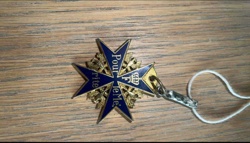
The item is a highly detailed cross-shaped medal, commonly known as a 'Pour le Mérite' (or Blue Max) of the Kingdom of Prussia. It features a Maltese cross design with eight points, approximately 4-5 cm in diameter based on visual estimation against the wood grain background. The arms of the cross are enameled in a vibrant dark blue, with narrow gold borders outlining each arm. The space between the cross's arms is filled with intricate gold-colored ornamentation, likely laurel wreaths, signifying honor and achievement. Each arm of the cross bears gold lettering: 'Pour le Mérite' (For Merit), with 'Pour' on the upper arm, 'le Mé.' on the lower arm, and 'rite' on the left arm, although portions of these words are obscured or abbreviated due to the object's orientation. The right arm of the cross features the intertwined royal cypher 'F' (for Frederick the Great) surmounted by a small crown. The reverse side, not fully visible, would typically feature the initial 'W' (for Wilhelm I, and later Wilhelm II) and the date '1870' (for awards during the Franco-Prussian War) or a later date if awarded post-unification.
The medal exhibits clear signs of age, including noticeable wear to the gold plating and the blue enamel, particularly around the edges and raised areas, consistent with a historical artifact that has been handled and displayed. There might be some minor abrasions or scratches on the enamel. The metal appears to be a gilded base metal, possibly bronze or silver, given its historical period and purpose. The overall craftsmanship suggests a high-quality manufacture, indicative of its status as a premier military award. Attached to the top of the cross is a small ring and a larger, somewhat crudely fashioned metal clasp or hook, which appears to be a later addition or repair, perhaps used to secure it to a string or ribbon. A white string is looped through this attachment, suggesting it might be an unmounted example or displayed. The overall appearance is consistent with an original example from the late 19th or early 20th century, specifically either from the Franco-Prussian War period (1870) or the World War I era (1914-1918), given the 'Pour le Mérite' was Prussia's highest military order until the end of the monarchy in 1918.
AI Appraisal Report
I have carefully examined the provided image of what appears to be a Pour le Mérite (Blue Max) Prussian Military Medal. Based on the visual characteristics, the design – a blue enamelled Maltese cross with gold borders, intricate gold ornamentation between the arms, and the prominent 'Pour le Mérite' inscription with 'F' cypher – is consistent with authentic examples of this prestigious award. The apparent wear on the gold plating and blue enamel suggests age and genuine use, not an artificial aging process. However, the crudely fashioned metal clasp and the white string appear to be later additions for display, and do not detract significantly from the medal's inherent value if it proves authentic.
Authenticating a high-value historical medal solely from an image is inherently limited. While the visual details align with an original, counterfeits of the Pour le Mérite are unfortunately common and can be highly deceptive. Therefore, I cannot definitively confirm its authenticity without an in-person, hands-on examination. Such an examination would involve:
* **Detailed metallurgical analysis:** To determine the exact composition of the metal and enamel, comparing it to known authentic examples.
* **Microscopic inspection:** To scrutinize the craftsmanship, enamel application, and any maker's marks or hallmarks that might not be visible.
* **Weight, dimensions, and construction:** Precise measurements are crucial as fakes often deviate subtly.
* **Provenance documentation:** A robust chain of ownership (from whom it was acquired, when, and how) is paramount. The information about 'Noah Dohme' and 'Lixland' is entirely irrelevant to the medal's historical provenance and does not provide verifiable ownership history of a historical artifact.
Assuming, for appraisal purposes, that an in-person examination and full provenance review confirm this to be a genuine late 19th or early 20th-century Pour le Mérite, its rarity and historical significance drive its value. The market for genuine Pour le Mérite medals is strong among serious collectors of militaria and historical artifacts. Comparables for authentic, good-condition examples can range significantly depending on the specific period of manufacture, individual condition, and unique provenance (e.g., if it belonged to a famous recipient). While wear is present, it appears consistent with age rather than damage. Therefore, if proven authentic:
* **Demand and Rarity:** Extremely high, as this was the highest Prussian military award, awarded to a select few.
* **Market Conditions:** Stable, with consistent demand for genuine pieces.
* **Factors Impacting Value:** Authenticity is the primary driver. Condition, specific maker if identifiable, and documented original recipient history would further enhance value.
Based on the visual information available, this piece *appears* to be a genuine, good-condition example. My appraisal value assumes that this piece will pass a rigorous in-person authentication. Without such authentication and a verifiable provenance, its value as an unauthenticated item is significantly lower, primarily as a decorative reproduction.