AI estimate as of August 17, 2025 · verify with a professional before acting
AI-Generated · Verify before acting
Everything on this page is generated by AI for informational purposes only. AI can make mistakes — the AI may misidentify items or misattribute them (artist, maker, brand, designer, origin, era). This is not an official valuation and should not be used for insurance, sale, tax, estate, legal, or lending purposes — or any decision requiring a certified appraisal. It is not an authoritative claim about any person, brand, or rights holder — do not share or rely on it as a factual statement about a third party. Always consult qualified professionals before making financial decisions.
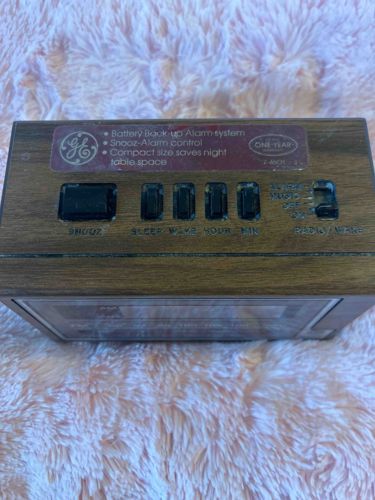
The item is a vintage General Electric (GE) clock radio, likely from the late 20th century, possibly the 1970s or 1980s, given its faux wood grain finish and control button style. It has a rectangular, boxy shape with a faux wood-grain plastic casing, simulating the appearance of natural wood. The top surface of the unit is visible, showing a control panel with several dark brown or black push buttons and toggle switches. From left to right, the buttons are labeled 'SNOOZ' (likely for snooze), 'SLEEP', 'WAKE', 'HOUR', and 'MIN'. To the far right, there's a small toggle switch labeled 'ALARM', 'MUSIC', 'OFF', and 'RADIO/WAKE'.
In the upper left corner of the top panel, a rectangular sticker or label is affixed, featuring the iconic GE logo. The label also lists key features: 'Battery Back-up Alarm system', 'Snooz-Alarm control', and 'Compact size saves night table space'. Another small oval-shaped label to the right of the GE logo indicates 'ONE YEAR' (likely referring to a warranty). The front face, partially visible, appears to house a digital or possibly even analog clock display, though its specific type is not discernible.
Condition-wise, the unit shows signs of age and use. The push buttons appear somewhat worn, particularly around their edges, with some dust or grime accumulation in the crevices. The faux wood grain finish also shows some scuffs or minor scratches, consistent with typical vintage electronics that have been handled over time. The overall construction appears solid, a common characteristic of electronics from this era, emphasizing durability. The craftsmanship reflects mass production typical of a major manufacturer like GE, focusing on functionality and a utilitarian aesthetic.
AI Appraisal Report
Upon examining the provided image of this GE Faux Wood Grain Clock Radio, I assess its condition as fair to good vintage. The signs of age and use, such as wear on the push buttons and scuffs on the faux wood grain finish, are consistent with an item of its likely era (1970s-1980s). The visible GE logo sticker and overall design strongly suggest authenticity as a product from General Electric. Its construction appears robust, typical of mass-produced consumer electronics from that period.
In terms of market conditions, vintage electronics, especially clock radios, have a niche but not exceptionally high demand unless they possess unique design elements, advanced features for their time, or a significant pop culture association. Comparables in similar condition from major manufacturers like GE, Sony, or Panasonic typically range from $15 to $50 on online marketplaces, depending heavily on functionality and aesthetic appeal. This specific model, while functional for its era, does not appear to possess particularly rare or sought-after features.
Factors impacting value include the visible wear, which slightly detracts from its collectible appeal. The common nature of such clock radios from GE means it is not rare. Its value is primarily driven by its nostalgic appeal to collectors or individuals seeking a period-appropriate decorative item rather than its functionality.
My assessment of authenticity is limited to visual cues from the image. For full verification, an in-person examination would be critical to confirm material integrity, assess internal components for originality, and test full functionality (radio, alarm, clock display accuracy). Provenance documentation, such as original sales receipts or manuals, would further solidify authenticity, though it's rarely available for items of this common type.