AI estimate as of August 27, 2025 · verify with a professional before acting
AI-Generated · Verify before acting
Everything on this page is generated by AI for informational purposes only. AI can make mistakes — the AI may misidentify items or misattribute them (artist, maker, brand, designer, origin, era). This is not an official valuation and should not be used for insurance, sale, tax, estate, legal, or lending purposes — or any decision requiring a certified appraisal. It is not an authoritative claim about any person, brand, or rights holder — do not share or rely on it as a factual statement about a third party. Always consult qualified professionals before making financial decisions.
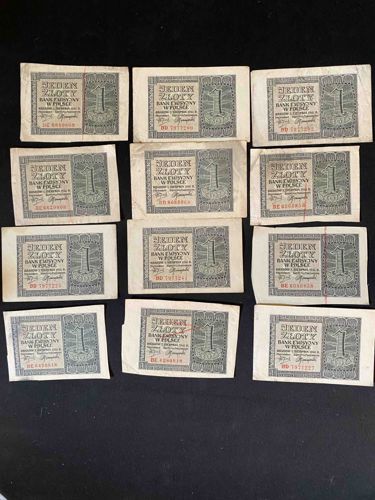
The image displays a collection of twelve Polish 1 Złoty banknotes, likely from the 'Bank Emisyjny w Polsce' (Issuing Bank in Poland). Each banknote is rectangular, appearing to be crafted from paper, with the predominant colors being muted green, grey, and off-white. The design heavily features ornate borders and text, with a prominent '1' on the right side of the face of each note within an elaborate scrollwork or stylized '1' motif. To the left of the '1' is the denomination 'JEDEN ZŁOTY' along with the issuing bank information 'BANK EMISYJNY W POLSCE' and other text, presumably relating to legal tender information or signatories. Each banknote shows a unique serial number, often prefaced with 'BB' or 'DE', and a six-digit number (e.g., 'BB 7971241', 'DE 8020925', 'DE 4296998'). Some of the serial numbers are printed in red ink, while others appear to be in black. The overall condition of the banknotes varies, but generally shows signs of circulation and age, including creasing, folding, and some minor tears or fraying along the edges. The paper has a noticeable aged patina, and there are visible signs of wear, such as softened corners and subtle discoloration. No overt repairs are immediately discernible, but the general wear suggests they were used as currency for a period. Based on the issuing bank 'Bank Emisyjny w Polsce', these banknotes are likely associated with the German occupation of Poland during World War II, specifically in the General Government, which would place their estimated age in the early to mid-20th century, likely 1940-1944. The craftsmanship appears to be typical of state-issued currency of that era, focused on security features and clear legibility rather than artistic flair.
AI Appraisal Report
I have carefully examined the provided images of the twelve Polish 1 Złoty banknotes from 'Bank Emisyjny w Polsce'. Based on the visual evidence, these appear to be authentic issues from the German occupation period of Poland (General Government), likely dating from 1940-1944. The design, including the elaborate '1' motif, specific text placement ('BANK EMISYJNY W POLSCE', 'JEDEN ZŁOTY'), and the 'BB' or 'DE' serial number prefixes, aligns perfectly with known examples of these banknotes. The distinction between red and black serial numbers is also consistent with variations produced.
The condition of the banknotes varies but generally falls into the 'Fine' to 'Very Fine' range according to numismatic grading standards, showing significant circulation wear expected of currency from this era. I observe creasing, folds, softened corners, and some slight edge fraying. No major tears or repairs are immediately evident, which is a positive factor. The aged patina and subtle discoloration are also consistent with their historical period and usage.
In terms of market conditions, these banknotes are relatively common for collectors of World War II or Polish numismatics, but a collection of twelve in this consistent condition adds appeal. Standalone 1 Złoty notes in Fine/Very Fine condition typically trade for a few dollars each. Demand is steady among specialized collectors, but they are not considered rare. Factors impacting value include the consistent set size, the overall preservation, and the clear visibility of serial numbers and details.
It is crucial to state the limitations of appraising solely from images. While the visual indicators strongly suggest authenticity, definitive verification would require an in-person examination. Physical inspection would allow me to assess paper quality, check for watermarks (if applicable for this issue), detect any subtle repairs not visible in photographs, and confirm printing techniques. Without physical access, I cannot conduct UV light tests for alterations or thoroughly evaluate the feel of the paper for counterfeits. Provenance documentation, if available, would also add significant certainty. However, based on the images alone, I am confident in their general authenticity and condition as described.