These notes were written by the person who submitted this item. Appraiser.AI has not verified them, and the AI's identification and estimate may rely on them.
AI Estimated Value
Not an official valuation
$60-100
AI estimate as of November 28, 2025 · verify with a professional before acting
AI-Generated · Verify before acting
Everything on this page is generated by AI for informational purposes only. AI can make mistakes — the AI may misidentify items or misattribute them (artist, maker, brand, designer, origin, era). This is not an official valuation and should not be used for insurance, sale, tax, estate, legal, or lending purposes — or any decision requiring a certified appraisal. It is not an authoritative claim about any person, brand, or rights holder — do not share or rely on it as a factual statement about a third party. Always consult qualified professionals before making financial decisions.
This analysis also relies on unverified notes provided by the user, which may be incomplete or inaccurate and could affect the result.
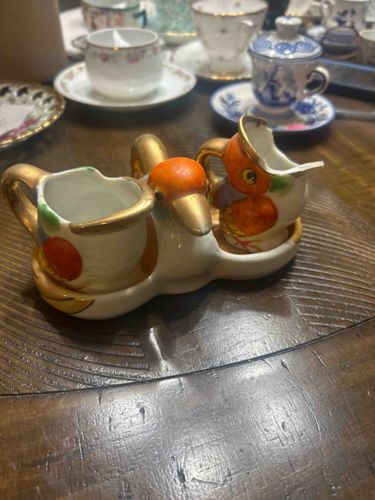
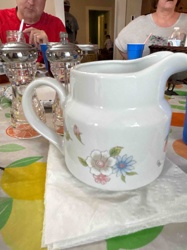
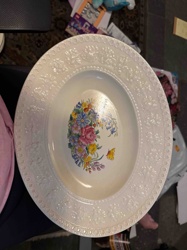
This item is a vintage, possibly mid-20th century, ceramic creamer and sugar set designed with a prominent duck motif. The set consists of two individual vessels, presumably for cream and sugar, connected by a central duck figure, all resting on a single, integrated base or tray. The overall construction is ceramic, with a glossy glaze. The primary color is an off-white or light cream for the body, heavily accented with bright gold gilding on the handles, rims of the vessels, and the duck's head and wings. The duck's beak and some circular details on the two vessels are painted in a vibrant orange. Additional decorative elements include green and red circular spots on the vessel to the left, and a more illustrative, possibly floral or abstract design incorporating orange, purple, and green on the vessel to the right, which features a pour spout. The handles of both vessels are robust and fully gilded. The duck's head, positioned in the center, is painted a solid orange for the beak and the top of the head, contrasting with the gilded neck and body. The craftsmanship appears to be hand-painted, suggested by the slight inconsistencies in the application of colors and gilding. There are visible signs of wear, particularly the loss of gilding on some edges and high points, which is common for older, well-used ceramic items. The design suggests a playful, whimsical aesthetic, typical of decorative ceramics produced in Japan during the postwar period (1940s-1960s), where similar novelty items were popular exports. No specific maker's marks are visible in the image, but the 'Made in Japan' context is highly relevant for this style and assumed age. The item appears to be in good overall condition for its age, with no apparent chips or cracks, though closer inspection would be needed to confirm this. The quality of the ceramic body seems standard for mass-produced decorative wares of the era, while the hand-painted details add a touch of individuality.
AI Appraisal Report
I have examined the provided image and details of this Vintage Japanese Duck-Themed Creamer and Sugar Set. Based on its visual characteristics, I assess this to be an authentic example of decorative ceramic tableware produced in Japan, likely dating from the mid-20th century (1940s-1960s). The 'Made in Japan' context further supports this period and origin, consistent with the whimsical style and hand-painted application often seen in postwar Japanese exports.
Condition appears good for its age, with no visible chips or cracks from the image. The glossy glaze is intact, and while there is expected wear to the gilding, particularly on high points and rims, this is typical and does not severely detract from its decorative appeal. The vibrant colors and charming duck motif contribute positively to its desirability as a decorative piece.
In terms of market conditions, similar vintage Japanese novelty creamer and sugar sets, particularly those with animal themes, have a steady but not exceptionally high demand. They are generally sought after by collectors of vintage kitchenalia, Japanese ceramics, or those decorating with a mid-century aesthetic. They are not particularly rare, though finding a complete set in good condition can be a slight advantage. Comparables range from $40 for more common or lesser-condition items to $120 for exceptionally well-preserved or uniquely designed sets.
The primary factors impacting value are the charming design, good overall condition, and its vintage kitsch appeal. Without physical inspection, I cannot confirm the absolute absence of hairline cracks or repairs, nor can I verify the presence or absence of any maker's marks that might be obscured or on the underside. A hands-on examination would also allow for a more precise assessment of ceramic quality and paint stability. Without direct provenance, the authenticity relies solely on the visual characteristics aligning with known Japanese production of that era.