AI Appraisal Estimate

AI-generated estimates · not official valuations

From the user

What was submitted

Photo and notes provided by the user — not generated by AI

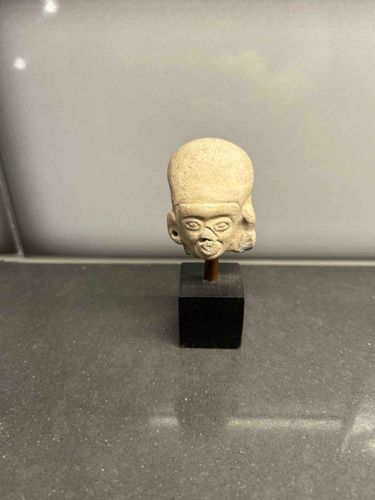
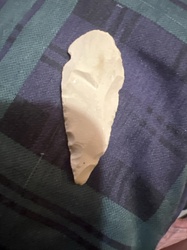
Submitted item photo
Submitted photo · May 18, 2026

User's notes

No additional notes provided.

AI analysis below

AI appraisal

AI analysis & estimate

AI-Generated · Verify before acting

Everything below is generated by AI for informational purposes only. AI can make mistakes — the AI may misidentify items or misattribute them (artist, maker, brand, designer, origin, era). This is not an official valuation and should not be used for insurance, sale, tax, estate, legal, or lending purposes — or any decision requiring a certified appraisal. It is not an authoritative claim about any person, brand, or rights holder — do not share or rely on it as a factual statement about a third party. Always consult qualified professionals before making financial decisions.

Read the full disclaimer

AI Identification

·Not independently authenticated·Verify before acting

Ancient Egyptian Style Faience or Terracotta Head of a Figure

Antiquities and Artifacts

AI Estimated Value

·Not an official valuation·Verify before acting

$400 - $800

As of May 18, 2026

AI Item Analysis

·AI can make mistakes·Verify before acting
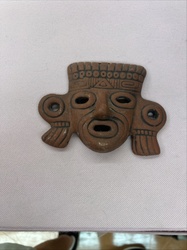
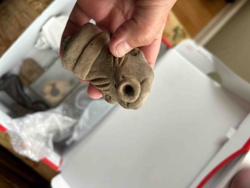
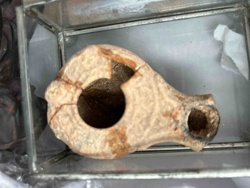
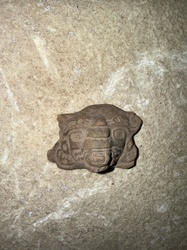
This small scupltural fragment depicts a human head, likely representing a deity or a royal figure, rendered in a style reminiscent of Ancient Egyptian or Near Eastern antiquities. The head is characterized by a tall, rounded headdress or elongated cranium, almond-shaped eyes with prominent outlined lids, and a flat nose. It appears to be made from a light-colored ceramic material, possibly weathered faience or terracotta, with a pale cream or buff-colored surface. The surface texture is somewhat granular and porous, typical of aged earthen materials. Proportionally, the ears are large and positioned high on the sides of the head. In terms of condition, there is significant weathering and damage visible: a large diagonal crack or loss runs across the bridge of the nose and lower face, and the lower right portion of the neck/jaw area is chipped or missing. There is also a dark stain or accretion on the right side of the head. The piece is currently mounted on a modern black wooden display plinth with a thin metal support rod. While it mimics the artistic conventions of the Late Period of Egypt or the Amarna period, a professional authenticity test would be required to determine if it is a genuine ancient artifact or a Grand Tour era reproduction.
AI Appraisal Report

·AI can make mistakes·Verify before acting
I have examined the provided images of this small sculptural fragment, which exhibits stylistic traits consistent with Late Period Egyptian or Amarna-style portraiture. The piece features the classic elongated cranium and almond-shaped eyes typical of the period. However, several visual markers suggest caution regarding antiquity. The surface texture, while appearing weathered, possesses a uniformity often seen in 19th-century 'Grand Tour' reproductions or early 20th-century tourist trade items. The significant diagonal loss across the nasal bridge and the staining on the right parietal region appear authentic to the material's degradation, yet the crispness of the ear contours despite the overall 'weathering' is atypical. The current market for Egyptian antiquities is highly sensitive to provenance. Without a documented chain of custody predating the 1970 UNESCO Convention, the value is significantly suppressed. Comparable authentic faience fragments of this size typically fetch $2,000-$5,000 at auction, but without proof of age or provenance, this item is valued primarily as a decorative object or study piece. A definitive valuation is impossible without physical inspection to determine if the core is true faience or a modern ceramic composite. I would require thermoluminescence (TL) testing to establish the last firing date and an examination under UV light to detect modern adhesives or surface treatments. Until such tests and provenance archives are provided, the value reflects its status as an attractive 'in the style of' piece.

Get your items appraised

Instant estimates of your treasures with AI-powered appraisals

Browse More Appraisals