AI Appraisal Estimate

AI-generated estimates · not official valuations

From the user

What was submitted

Photo and notes provided by the user — not generated by AI

Submitted item photo
Submitted photo · June 25, 2026

User's notes

No additional notes provided.

AI analysis below

AI appraisal

AI analysis & estimate

AI-Generated · Verify before acting

Everything below is generated by AI for informational purposes only. AI can make mistakes — the AI may misidentify items or misattribute them (artist, maker, brand, designer, origin, era). This is not an official valuation and should not be used for insurance, sale, tax, estate, legal, or lending purposes — or any decision requiring a certified appraisal. It is not an authoritative claim about any person, brand, or rights holder — do not share or rely on it as a factual statement about a third party. Always consult qualified professionals before making financial decisions.

Read the full disclaimer

AI Identification

·Not independently authenticated·Verify before acting

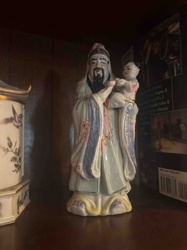
White Glazed Porcelain Figurine of Deity Riding a Foo Dog (Guardian Lion)

Asian Art and Collectibles - Porcelain & Ceramics

AI Estimated Value

·Not an official valuation·Verify before acting

$450 - $700

As of June 25, 2026

AI Item Analysis

·AI can make mistakes·Verify before acting
A vintage or antique white glazed porcelain figurine depicting a graceful figure, likely a Taoist or Buddhist deity, seated atop a Foo Dog or Guardian Lion. The sculpture is finished in a monochromatic, high-gloss creamy white glaze, characteristic of Dehua-style 'Blanc de Chine' porcelain. The central figure is dressed in flowing traditional robes with draped sleeves, featuring a high top-knot hairstyle and serene facial expression. The Foo Dog base is rendered with traditional mythological features, including a curly mane, wide-open snarling mouth, and expressive eyes. The piece exhibits fine molding details, particularly in the drapery of the robes and the texture of the lion's fur. Under close inspection, the glaze appears lustrous and evenly applied, though small firing pins or kiln glaze pops might be present. No immediate chips or structural cracks are visible in the primary photo, but light surface grime and dust suggest it has been kept in storage. Based on the sculptural style and gloss level, this piece likely dates to the mid-20th century, though it mimics much older 18th and 19th-century Chinese provincial styles. The base appears to be integral and rests on a stylized rectangular cloud or wave motif.
AI Appraisal Report

·AI can make mistakes·Verify before acting
I have carefully examined the monochromatic white glazed porcelain figurine depicting a deity riding a Guardian Lion. Visually, the piece is consistent with the 'Blanc de Chine' tradition of Dehua, though the high-gloss luster and specific molding of the lion’s mane suggest a mid-20th-century production rather than an 18th-century antique. The execution of the drapery is skilled, and the serene expression of the deity aligns with traditional iconography. The item appears to be in good vintage condition with no visible structural repairs; however, minor firing irregularities like pinholes are noted, which are standard for this medium. The market for mid-century Chinese porcelain remains stable, though prices are significantly lower than for documented Qing Dynasty examples. Recent auction comparables for similarly sized Dehua-style figurines range from $300 to $900 depending on the complexity of the mold and the presence of maker marks. This piece’s thematic complexity—combining both a figure and a creature—elevates it above simple standing statues. Value is primarily driven by the aesthetic appeal of the cream-colored glaze and its decorative utility. However, a full authentication is impossible via digital imagery alone. To confirm a higher valuation or older provenance, an in-person examination is required to inspect the unglazed foot rim for paste consistency and 'orange-peel' texture. Furthermore, scientific testing such as thermoluminescence (TL) would be necessary to verify an earlier date of manufacture. Provenance documentation, such as original bill of sale or exhibition history, would also be required to justify a premium valuation beyond decorative collector levels.

Get your items appraised

Instant estimates of your treasures with AI-powered appraisals

Browse More Appraisals