AI estimate as of December 5, 2025 · verify with a professional before acting
AI-Generated · Verify before acting
Everything on this page is generated by AI for informational purposes only. AI can make mistakes — the AI may misidentify items or misattribute them (artist, maker, brand, designer, origin, era). This is not an official valuation and should not be used for insurance, sale, tax, estate, legal, or lending purposes — or any decision requiring a certified appraisal. It is not an authoritative claim about any person, brand, or rights holder — do not share or rely on it as a factual statement about a third party. Always consult qualified professionals before making financial decisions.
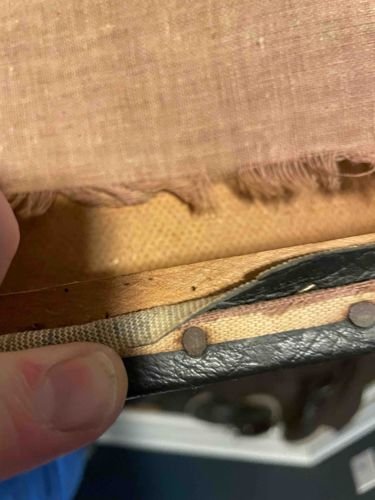
The item appears to be a close-up detail of the underside or back edge of an antique or vintage upholstered furniture piece, likely a chair, sofa, or settee. The visible elements include multiple layers of materials characteristic of traditional upholstery methods. The uppermost layer is a light tan or ecru colored coarse woven fabric, possibly burlap or a similar natural fiber, showing significant fraying and wear along its edge. Below this, there is an underlying structure of what appears to be a wooden frame element, dark brown in color, with some dark specks that could be dirt, dust, or possibly minor insect activity. Adjacent to the wood, a strip of lighter, tan-colored woven fabric with faint parallel dark stripes is visible. This strip is secured with multiple darkened, small domed tacks (upholstery nails), suggesting it is pulled taut over the frame. Directly beneath these tacks and the striped fabric is a darker, possibly black or very dark brown, textured material that appears to be leather or a leatherette, showing a slightly wrinkled or pebbled surface. The overall construction reveals a multi-layered approach to upholstery, with the use of natural fabrics, tacks, and possibly leather, indicative of a style period ranging from the late 19th to mid-20th century. The visible wear, fraying, and aged patina on the fabrics and tacks suggest a substantial age and consistent use. The craftsmanship, though not fully visible in its entirety, indicates a traditional manual upholstery application where materials are stretched and secured by hand.
AI Appraisal Report
I have examined the provided image of an upholstered furniture edge with exposed tacks. This detail shot reveals layers of traditional upholstery, including a coarse woven fabric (likely burlap), a striped fabric strip secured with antique-style upholstery tacks, and a darker material, possibly leather or leatherette, underneath. The construction methods, particularly the use of individual tacks and natural fibers, are consistent with furniture manufacture from the late 19th to mid-20th century. The visible fraying, wear on the fabrics, and darkened patina on the tacks strongly suggest considerable age and usage, indicating authenticity as a vintage or antique component.
Assessing the condition from a detail image, the wear is significant, which would be expected for a furniture piece of that age. However, this is just a component detail, not a complete furniture piece. As such, the market value for this *component* is limited. While authentic, its primary value lies in contributing to the overall integrity and historical accuracy of the larger furniture item it belongs to. Demand for such a specific, worn component is very low unless it's for restoration of a highly significant or rare piece. Individually, its intrinsic value is minimal, primarily resting on potential use for academic study of upholstery techniques or as a donor piece for very specific, small-scale repairs.
Without seeing the entire furniture piece, I cannot comment on its overall condition, style, or quality, which would dictate the true value. The dark specks on the wood are concerning and would require an in-person examination to rule out active insect infestation. Furthermore, a physical inspection would allow for tactile assessment of fabric types, confirmation of the leather/leatherette material, and closer examination of tack construction for definitive dating. Provenance documentation for the larger furniture piece would be crucial for establishing higher value. Based solely on this image as a standalone component detail, I estimate its value to be $50-$150. This is a conservative estimate, reflecting its fragmented nature and limited utility outside of a complete, valued furniture item.