AI estimate as of September 8, 2025 · verify with a professional before acting
AI-Generated · Verify before acting
Everything on this page is generated by AI for informational purposes only. AI can make mistakes — the AI may misidentify items or misattribute them (artist, maker, brand, designer, origin, era). This is not an official valuation and should not be used for insurance, sale, tax, estate, legal, or lending purposes — or any decision requiring a certified appraisal. It is not an authoritative claim about any person, brand, or rights holder — do not share or rely on it as a factual statement about a third party. Always consult qualified professionals before making financial decisions.
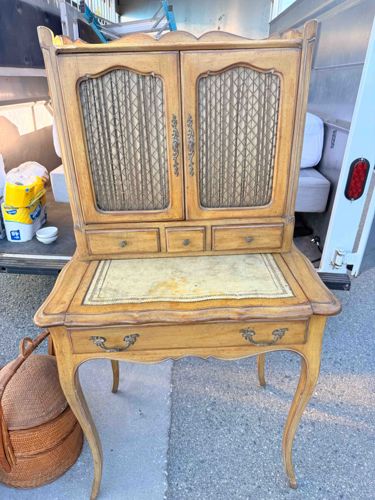
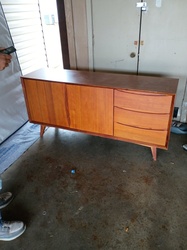
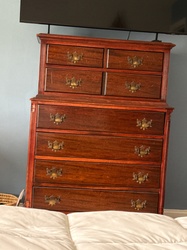
This is a French Provincial style secretaire desk, likely crafted from light-colored wood such as maple or a similar species, exhibiting a warm, natural wood finish. The overall form combines a desk base with a hutch-like cabinet top. The top section features two cabinet doors with a distinct scalloped or shell-like carving along the top edge of the cornice. Each door has a recessed panel with an elegantly curved or shaped border, enclosing a decorative metal grillework. The grille appears to be a diamond or crisscross pattern, possibly in a brass or aged gold tone, with a fabric backing, possibly cane or a mesh, visible through it. Between the two doors, there's a vertical molded accent with some subtle decorative carving. Below the cabinet doors, there are three small drawers across, each fitted with a simple, possibly brass, ring pull or knob. The desk surface is a drop-front or pull-out writing surface, featuring a light-colored, possibly leather or faux-leather, insert with a subtle textured pattern and a darker border. This writing surface shows significant wear, discoloration, and staining, indicating heavy use or age. Below the writing surface, the desk base includes a long, single drawer with two ornate, bronze-toned drawer pulls with an escutcheon-like backplate. The apron of the desk below this drawer is subtly scalloped. The desk is supported by four cabriole legs, characteristic of the French Provincial style, which curve gracefully to scrolled feet (though the very bottom of the feet is not clearly visible). The wood exhibits a noticeable patina, with some scuffs, scratches, and finish wear consistent with age and use. There are no visible maker's marks or signatures in the provided image. The craftsmanship appears to be of a good-to-moderate quality, typical of mass-produced or semi-custom furniture from the mid-20th century, likely dating from the 1950s to 1980s, aiming to replicate historical French designs.
AI Appraisal Report
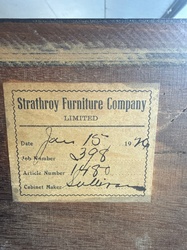
Upon my virtual examination of this French Provincial style secretaire desk with cabinet top, I assess its condition as fair to good, consistent with its likely age. The warm, natural wood finish shows a noticeable patina, साथै scuffs, scratches, and wear typical of a piece from the mid-20th century. The most significant condition issue is the highly worn, discolored, and stained writing surface, which will require restoration for optimal appearance and function. The decorative metal grillework appears intact, as do the cabriole legs and their scrolled feet, though their exact condition at the base is not fully discernible. Authenticity-wise, this piece appears to be a mass-produced or semi-custom reproduction in the French Provincial style, rather than an antique original. The general construction and stylistic elements point to a manufacturing period likely between the 1950s and 1980s. I find no indication of maker's marks, which is common for such reproductions.
In terms of market conditions, French Provincial reproductions from this era generally fall into the mid-range furniture category. Demand is moderate, appealing to those seeking a classic, elegant aesthetic without the high cost of true antiques. Rarity is low; similar pieces are not uncommon in the secondary market. Factors significantly impacting its value include the worn writing surface, which detracts from its overall appeal and functionality, and the absence of any notable maker or provenance. Comparables from online marketplaces and auction results for similar condition pieces typically range from $250 to $600 depending on location and specific features.
Limitations of this appraisal include the inability to physically inspect the piece for structural integrity, drawer function, or hidden damage. A hands-on examination would allow me to verify wood species, exact construction methods, and the full extent of wear on all surfaces. Furthermore, without provenance documentation or scientific dating, the exact manufacturing period is based solely on stylistic cues. An in-person inspection could also potentially uncover any subtle maker's marks not visible in the provided images.