AI Appraisal Estimate

AI-generated estimates · not official valuations

From the user

What was submitted

Photo and notes provided by the user — not generated by AI

Submitted item photo
Submitted photo · May 23, 2026

User's notes

No additional notes provided.

AI analysis below

AI appraisal

AI analysis & estimate

AI-Generated · Verify before acting

Everything below is generated by AI for informational purposes only. AI can make mistakes — the AI may misidentify items or misattribute them (artist, maker, brand, designer, origin, era). This is not an official valuation and should not be used for insurance, sale, tax, estate, legal, or lending purposes — or any decision requiring a certified appraisal. It is not an authoritative claim about any person, brand, or rights holder — do not share or rely on it as a factual statement about a third party. Always consult qualified professionals before making financial decisions.

Read the full disclaimer

AI Identification

·Not independently authenticated·Verify before acting

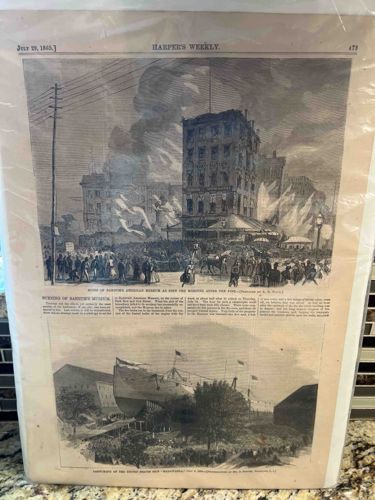
Harper's Weekly Page, July 29, 1865 edition

Ephemera & Historical Documents

AI Estimated Value

·Not an official valuation·Verify before acting

$45.00 - $65.00

As of May 23, 2026

AI Item Analysis

·AI can make mistakes·Verify before acting
This is an original page from the July 29, 1865 issue of Harper's Weekly, a highly influential American political magazine of the 19th century. The page features a large wood-engraved illustration titled 'RUINS OF BARNUM'S AMERICAN MUSEUM AS SEEN THE MORNING AFTER THE FIRE.' This dramatic scene depicts the aftermath of the fire that destroyed P.T. Barnum's famous New York City landmark. Below the main illustration is a detailed news report and a second, smaller engraving titled 'LAUNCHING OF THE UNITED STATES SHIP MADAWASKA.' The page is printed on typical period newsprint (wood pulp or rag paper) with black ink. The upper edge shows the publication date and page number 473. The condition appears fair to good for its age; there is visible yellowing and foxing consistent with old paper, and it is currently protected in a plastic sleeve. The printing shows the fine, cross-hatched detail characteristic of 19th-century wood engraving, a labor-intensive illustrative technique. Notable elements include the depiction of Victorian-era crowds, horse-drawn carriages, and the charred shell of the five-story museum building. This artifact serves as a significant primary source document regarding both the history of American entertainment and naval construction during the tail end of the Civil War era.
AI Appraisal Report

·AI can make mistakes·Verify before acting
I have examined the digital representation of this original leaf from the July 29, 1865, edition of Harper's Weekly (page 473). The page features a central wood-engraved illustration of the catastrophic fire at P.T. Barnum's American Museum. Based on my visual analysis, the piece appears to be an authentic period printing on standard mid-19th-century wood-pulp/rag newsprint. The woodblock cross-hatching and typography are consistent with Harper & Brothers’ production standards of 1865. The condition is categorized as fair-to-good. There is evident foxing (brown spotting) and oxidation-induced yellowing, which are expected for this era but do impact value. The margins appear largely intact, though potential edge brittleness or minor tears hidden by the protective sleeve may exist. Market demand for PT Barnum ephemera remains steady among collectors of New York City history and circus memorabilia. However, because this is a single page detached from a complete issue of Harper's Weekly (which typically contains 16 pages), the value is significantly lower than a full bound volume or a complete pristine issue. Comparable sales for individual 1865 Harper's sheets with notable illustrations generally fall in the sub-$100 range. Note: This appraisal is based on image analysis and cannot account for paper texture, weight, or hidden repairs. Definitively confirming authenticity would require an in-person examination to verify the ink-to-paper depth and scent. No scientific testing or provenance documentation was provided. For a full authentication, physical inspection is required to ensure this is not a modern offset-lithograph reproduction, though the presence of foxing suggests period authenticity.

Get your items appraised

Instant estimates of your treasures with AI-powered appraisals

Browse More Appraisals