Chinese Bronze Fangding-Style Censer
Asian Antiques / Metalware

Chinese Bronze Fangding-Style Censer

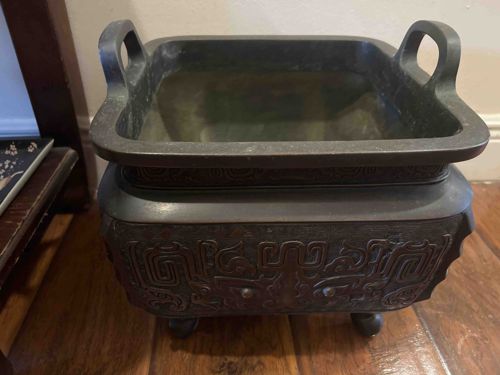
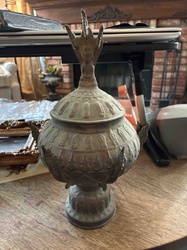
This is a rectangular bronze incense burner, known as a censer, modeled after the ancient ritual 'fangding' vessels of the Shang and Zhou dynasties. It is constructed from a heavy cast copper alloy, likely bronze with a high lead or tin content, and features a dark brown-black aged patina. The vessel has a square-lipped mouth with two upright u-shaped handles (ears) and is supported by four short cabriole-style feet. The body is decorated with low-relief archaic motifs, specifically a stylized taotie (monster mask) pattern on each face, characterized by symmetrical swirling leiwen (thunder patterns). A narrow band of scrolling thunder patterns also encircles the neck of the vessel. Physically, the item shows signs of significant age and use, including a thick layer of dust and surface oxidation, as well as remnants of white ash or incense residue in the interior cavity. There are minor abrasions and surface scuffs consistent with handling and a possible small dent on the upper lip, but no structural cracks or major repairs are immediately visible. The craftsmanship suggests a 19th or early 20th-century manufacture (Qing dynasty or Republic period), emulating the bronze-working traditions of earlier centuries with solid casting and hand-finished decorative detailing.
Estimated Value

$400 - $600 USD

Basic Information

Category

Asian Antiques / Metalware

Appraised On

February 8, 2026

Estimated Value

$400 - $600 USD

Item Description

This is a rectangular bronze incense burner, known as a censer, modeled after the ancient ritual 'fangding' vessels of the Shang and Zhou dynasties. It is constructed from a heavy cast copper alloy, likely bronze with a high lead or tin content, and features a dark brown-black aged patina. The vessel has a square-lipped mouth with two upright u-shaped handles (ears) and is supported by four short cabriole-style feet. The body is decorated with low-relief archaic motifs, specifically a stylized taotie (monster mask) pattern on each face, characterized by symmetrical swirling leiwen (thunder patterns). A narrow band of scrolling thunder patterns also encircles the neck of the vessel. Physically, the item shows signs of significant age and use, including a thick layer of dust and surface oxidation, as well as remnants of white ash or incense residue in the interior cavity. There are minor abrasions and surface scuffs consistent with handling and a possible small dent on the upper lip, but no structural cracks or major repairs are immediately visible. The craftsmanship suggests a 19th or early 20th-century manufacture (Qing dynasty or Republic period), emulating the bronze-working traditions of earlier centuries with solid casting and hand-finished decorative detailing.
Get Your Items Appraised

Instant estimates of your treasures with AI-powered instant appraisals

Browse More Appraisals