AI Appraisal Estimate

AI-generated estimates · not official valuations

From the user

What was submitted

Photo and notes provided by the user — not generated by AI

Submitted item photo
Submitted photo · June 15, 2026

User's notes

No additional notes provided.

AI analysis below

AI appraisal

AI analysis & estimate

AI-Generated · Verify before acting

Everything below is generated by AI for informational purposes only. AI can make mistakes — the AI may misidentify items or misattribute them (artist, maker, brand, designer, origin, era). This is not an official valuation and should not be used for insurance, sale, tax, estate, legal, or lending purposes — or any decision requiring a certified appraisal. It is not an authoritative claim about any person, brand, or rights holder — do not share or rely on it as a factual statement about a third party. Always consult qualified professionals before making financial decisions.

Read the full disclaimer

AI Identification

·Not independently authenticated·Verify before acting

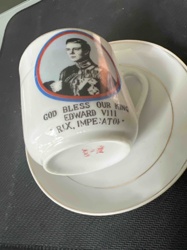
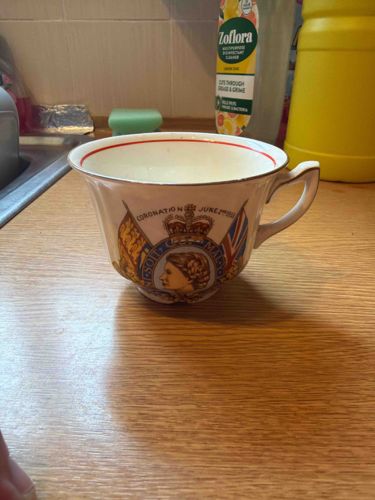
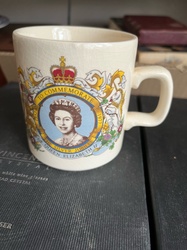
Queen Elizabeth II Coronation Commemorative Teacup (1953)

Royal Commemoratives / Collectible Ceramics

AI Estimated Value

·Not an official valuation·Verify before acting

$15.00 - $25.00

As of June 15, 2026

AI Item Analysis

·AI can make mistakes·Verify before acting
This is a vintage ceramic commemorative teacup produced to celebrate the coronation of Queen Elizabeth II on June 2nd, 1953. The cup features a fluted, gently outward-curving rim and a standard loop handle with a small thumb rest. The central decoration consists of a detailed transfer-printed profile portrait of a young Queen Elizabeth II, encircled by a garter-style banner and flanked by the Union Jack and the Royal Standard flags. Above the imagery, the text 'CORONATION JUNE 2nd 1953' is clearly visible. The interior rim is accented with a simple red pinstripe banding. Physically, the cup appears to be made of fine bone china or high-quality earthenware, common for British mass-market commemoratives of this era. Regarding condition, there is visible wear to the gold-tone gilding on the rim and handle, suggesting frequent use or handling. Signs of light staining or crazing may be present in the interior bottom based on the yellowish tint. No major cracks or chips are immediately apparent from the primary angle, but there is some minor pitting and surface grime consistent with age and storage in a kitchen environment. Small imperfections in the transfer application are typical of these souvenir pieces, reflecting mid-century industrial manufacturing quality.
AI Appraisal Report

·AI can make mistakes·Verify before acting
I have virtually examined this Queen Elizabeth II 1953 Coronation commemorative teacup. Based on the transfer-print design and fluted form, I identify this as a genuine period souvenir, likely produced by a Staffordshire pottery firm such as Alfred Meakin or Tuscan for the mass market. The profile portrait and flag arrangement are iconic motifs of the era. The condition is Fair to Good; significant gilt loss is evident on the rim and handle, and visible interior staining suggests the glaze has likely crazed over time. These issues are common for utilitarian commemoratives but do detract from the top-tier 'mint' value. The market for mid-century royal commemoratives is currently saturated; millions of these items were produced and kept as family keepsakes, making them relatively common today. While there is a consistent baseline of interest from 'Royalist' collectors, value is heavily dictated by condition and the prestige of the manufacturer (e.g., Wedgwood or Royal Doulton), which appears absent here. This specific piece serves more as a charming historical memento than a high-yield investment. This appraisal is based solely on the provided imagery. A full authentication would require an in-person inspection to check for a maker's mark on the base, which would confirm the specific pottery house and quality grade. I would also need to use a high-intensity UV light to detect professional restorations or hidden hairline fractures that are not visible in standard photography. Documented provenance connecting the piece to a specific 1953 localized celebration could marginally increase its historical interest.

Get your items appraised

Instant estimates of your treasures with AI-powered appraisals

Browse More Appraisals